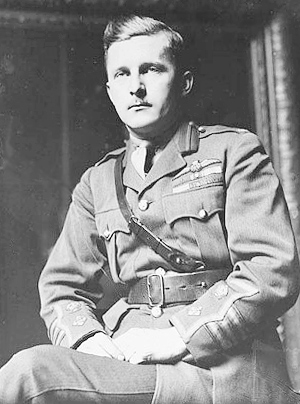
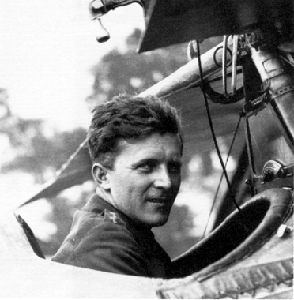
Billy Bishop was born in Owen Sound, Ontario on Feb 8th, 1894. He was educated at the Royal Military College (RMC) in Kingston, Ontario. Bishop was qualified as a pilot in December, 1916. He had joined the Royal Flying Corps, and flew a Nieuport 17. From March 25th 1917 to June 19, 1918, Billy had destroyed over 25 enemy aircraft. He participated in over 170 air battles. In total, he was given credit for 72 kills, and was the third highest Ace Allied total. In one of Bill's battles, he had shot down five enemy aircrafts, in a five minute period. Bishop was promoted to the rank of lieutent colonel and was given command of the 85th Squadron in 1918, Billy was successfully awarded the Military Cross, Distinguished Service Award, and the Victoria Cross. He had a reputation of an accurate shooter, but a lousy pilot. The Germans had given Billy a nickname of 'Hell's Handmaiden'. William Avery Billy Bishop died quiety in his sleep on September 11th, 1956.
Brief Summary .....^
Billy Bishop was awarded the Victoria Cross, Great Britains highest military award .
Quotes by Billy ; "Better to die voluntarily crashing than to have the enemy send you down in flames"
AND
"The Air Age faces mankind with a sharp choice -the choice between winged Peace, or winged Death. It's up to you"
William Avery Billy Bishop was one of the greatest fighter pilots of the British commonwealth. As a boy growing up, Billy practiced shooting moving targets. At the age of 17, he was attending the Royal Military College (RMC), but had failed his first year there. When the World War One broke out in 1914, Billy had left the RMC and joined the Mississauga Horse Regiment, he was commissioned as an officer but was ill with pneumonia when the regiment was sent overseas. After Bishop had recovered, he then transferred to the 7th Canadian Mounted Rifles, then he was stationed in London, Ontario. Billy had then left Canada for England on June 9th, 1915, but then in July (1915), he transferred to the Royal Flying Corps as an observer, due to frustration with the mud of the trenches and the lack of action in the calvary. On September 1st, Billy had reported 21 (fighter pilots training) in 1916, and flew his first aircarft (Avro 504) The first fight Billy was in, was in March 1917. Billy first shot down one plane (a German plane), the later destroyed 13 planes (within a five day period). Bishop had attacked a German air base near Cambrai, France. Two planes had chased Billy, buh he shot down both, and then two more had came to attack, one had fallen, taken from a shot of his gun (deadly fire), the other plane had driven off. Billy returned home safely. Their was also another time when the German ground guns had hit Billy's fuel tank, with his plane on fire, he still made it back to Allied territory, but had crashed into a tree. It had been raining, so the rain had set the fire out that was on Billy's plane, but he was badly shaken. At the end of war, Billy was rewarded the Victoria Cross by Britain, and had achieved the highest honours of France. He was one of the three Allied Air Aces. Billy had bacome a director of recruiting for the Royal Canadian Air Force in 1940.
William Avery Billy Bishop
Saturday, October 24, 2009
History Project 'CANADA'S ROLE IN WORLD WAR ONE'
Monday, September 21, 2009
Variety;; In this picture it shows varitey by having variety in colour, and some-what different sizes of the rocks.
Emphasis;; This picture emphasizes the lights at the bottom hitting the top of the dark tunnel, drawing yours eyes from down, to upwards.
Proportion;; In this fabulous picture it shows a giant fork in a lake. Your eyes catch straight to the fork.
Rhythm;; this picture shows rhythm by repeating a pattern. (flowers and the leaves)
Harmony;; this picture represents harmony because the colours go together. :) (they look good together)
Thursday, September 17, 2009
Shape;; In this picture their are many squares put together and they're shapes.
Form;; In this picture, it's in the process of buliding a snowman.
Space;; This picture represents form, because your looking from down, to up.
Balance;; In this painting its symmetrical, so if you were to fold it in half, it'd be the reverse (like looking in a mirror)
Shade;; this painting has shade, because their are different shades varieying from black to white.
Line;; In this picture, it's showing a few types of lines : straight lines and curved lines.
Texture;; In this picture, its showing texture with silk, which is smooth and soft.